Written by

Bendik Eide Anskau
In my opinion, it is unacceptable for a closer to produce less than $100,000 a month in collected revenue. That's the bare minimum.
On the offers we manage, we expect a single closer to be able to produce multiple six figures a month. But I constantly see bloated sales teams where the average revenue per closer is far below this. Teams where there are 3 to 5 closers fighting for scraps and managers who have no real control of the operation.
My name is Bendik, and I run Closing Consulting. We build, staff, and run sales operations for high-ticket info, coaching, and service businesses. Between my own companies and the clients we've worked with, we've pushed well into 8 figures through setter-closer teams.
In this piece I'm going to show you exactly how to think about revenue per closer the way an operator does: the exact numbers we use to judge whether a closer is actually working, how to squeeze more revenue out of the closers you already have, and when it actually makes sense to add another one.
Why Low Revenue Per Closer Breaks Everything
If your average closer is bringing in less than $100,000 a month in collected revenue, you've got three serious problems.
First, you can't keep or attract top talent. Most closers do a simple calculation: "I get around 10% commission. If I bring in $100K, I make $10K a month." Ten thousand a month is the mental minimum benchmark for a professional closer. Love it or hate it, the whole industry has been built on that number. So if your system caps most reps at $5K or $8K a month, B-players will eventually leave for offers where they can see a clear path to $10K or more, and A-players won't even come in for an interview. The best closers only consider multi-five-figure monthly on-target earnings. You don't have to overpay people, but to hold even B-level talent, your economics per closer have to support at least that $100K to $200K range. If they can't get there on your offer, they'll go somewhere else.
Second, you get more complexity for the same money. If revenue per closer is low and you try to solve your growth problems by adding more closers, here's what you actually end up with: more people to manage, more inconsistency in how calls are run, and more overhead around training, management, and the inevitable drama about who gets what leads.
Third, scaling turns into a headcount nightmare. Do the math. If a closer does $50K a month, you need 20 closers to get to $1M. If a closer does $100K, you need 10. If a closer does $200K, you need 5. Same revenue target, but a completely different org chart. If you don't solve this now at low six figures, you're going to drown in complexity and chaos trying to get to seven.
The Three Numbers That Actually Matter
There are three core KPIs that tell you how well you're using each closer on your team.
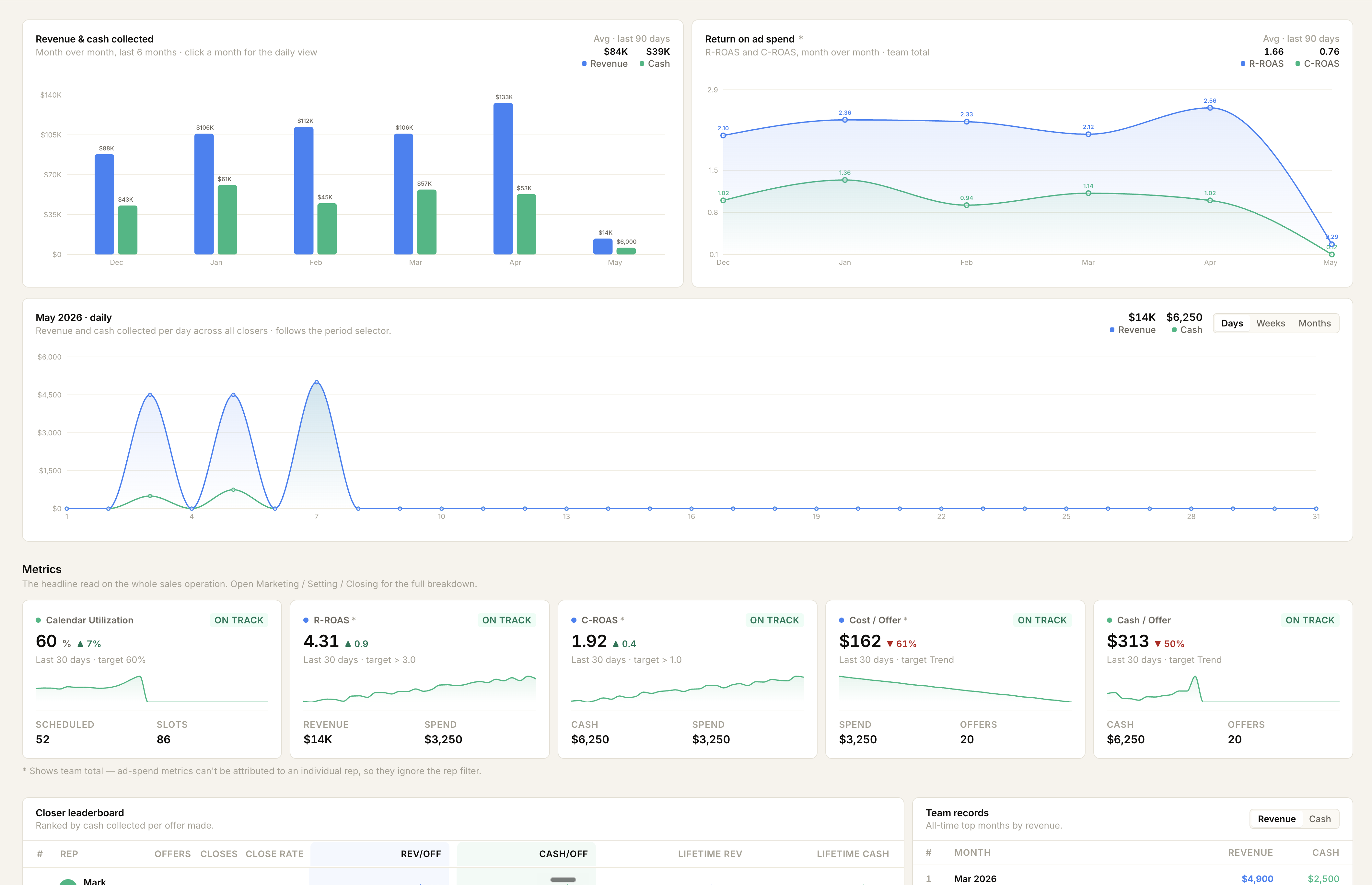
Number one: Utilization rate. This is the total number of calls scheduled divided by total available call slots on the calendar. If a closer has 40 available slots in a week and there are 20 calls on the calendar, the utilization rate is 50%. This number tells you how well you're using the closer's available capacity.
Number two: Offers per scheduled call. This is the number of offers made divided by calls scheduled. For every call on the calendar, we want to know: did the person show, and were they qualified enough to actually pitch? This metric captures both show rate and how well the setter qualified the leads.
Here's an example. Say you have 100 calls scheduled, 75 show up, and of those you make 50 offers. Your offers-per-scheduled rate is 50%. What that really means is that half of what's on the calendar is garbage. Whether they don't show or are unqualified, it's wasted capacity. If you took that number from 50% to 75%, each closer could effectively produce 50% more revenue spending the exact same amount of time on calls.
Number three: Cash collected per scheduled call. This is total cash collected divided by total calls scheduled. It tells you how much a scheduled call is worth to you, how much you can afford to pay per call, and combined with utilization, how many closers you actually need to hit your revenue targets.
These three numbers together tell you exactly what's broken. Low utilization means a volume problem, not enough calls coming in. Low offers per scheduled call means a setting or lead quality problem. Low cash per call despite good utilization and offer rate means a closing problem. Once you know which number is off, you know what to fix.
How to Make More Money With the Closers You Have
Starting with utilization rate.
The target should be around 70%. Here's why: with 45-minute calls and a 9-hour workday, each closer has roughly 12 available slots per day. 70% of that is about 8 calls, which blocks around 6 to 6.5 hours for calls and leaves the closer enough time to follow up on their pipeline, send proposals, drop case studies to people sitting on the fence, and do all the other work that actually moves deals forward. It also keeps them hungry. There's not an endless supply of calls, so they know they need to make the most of the ones they have.
If utilization is way above 70%, say 85% or 90%, and your other two numbers are strong, that's the sign you have too many calls for the closer to handle. You need to add capacity.
If utilization is too low, say all three closers are sitting at 40% or 50%, you've got two options. Option one is to ramp ad spend if you're profitable enough to fill everyone's calendar. But if your ads were that profitable, you'd already be doing it. So option two is to create competition. Have all three closers compete for the calls, identify who's performing worst, and let that person go. What that does is automatically pull up utilization for the two remaining closers. They make more money. And because you cut the weakest performer, you're now squeezing more cash out of the same spend, so ROAS improves without changing anything else. If you have genuinely good sales talent, they'll welcome this kind of competition.
Now, offers per scheduled call.
This number is made up of two things: show rate, and of the people who show, how many are qualified enough to pitch.
Show rate realistically lands between 60% and 75% depending on the offer, traffic source, how warm the audience is, and who you're selling to. Below that range, you need to work with your setter team specifically on show rate.
Here's how you actually move this number. First, your setters need to be actively confirming every appointment on the calendar, not just sending a reminder text. If a setter can identify someone who's going to no-show and replace them with someone who will actually show, that lifts the show rate on scheduled calls substantially. It also brings down the closer's effective utilization, because if their calendar is 70% full but the offer rate is terrible, you're just wasting their time. You want offer rate high enough that when the closer's utilization does hit 70%, nearly every one of those calls is a real opportunity.
Second, your setters need to actually qualify leads, not just confirm the Zoom link. The setters we run spend real time on the phone with every lead to make sure they're the right fit, showing up with the right mindset, and have reviewed the right material beforehand. Because whether or not someone is ready to buy isn't binary. It's a spectrum. And the setter's job is to push that person further along the spectrum before they ever sit down with a closer, which shortens the gap the closer has to close on the call and directly increases close rate.
Finally, cash collected per scheduled call.
This is about how well a closer can turn an opportunity into cash. It's also the cleanest comparison metric you have across your team, because the cost of booking a call from advertising is the same for every closer. If you're spending $500 to book a call, that's true for all three reps. But one closer might produce $700 cash per call, another $2,000, and another $3,000. That number tells you exactly who to send calls to.
Let me make the math concrete. Closer 1 has $1,000 cash per call. Closer 2 has $2,000. If they each get 100 calls a month and lead quality is evenly distributed, you're losing $100,000 a month in revenue from that performance gap alone. Shifting those 100 calls from Closer 1 to Closer 2 would produce 33% more revenue from the same ad spend, the same marketing effort, and the same backend work. That's why this metric matters so much.
When to Actually Add Another Closer
We start thinking about adding a closer when utilization rate is consistently sitting at or approaching 70%, and when cash per scheduled call shows a ROAS that's profitable enough to scale hard.
But the last thing you want to do if you're not highly profitable is add headcount. It's almost always better to optimize ROAS by tightening the operation you have, or replacing a weak performer with a stronger one.
And when you do add a closer, you need two things to be true: ROAS is strong enough to support it, and you have enough marketing power to generate enough new calls that you don't just end up spreading the same volume across more reps. Because if you add a closer and the calendar doesn't grow proportionally, one of two things happens. Either the new closer sits idle and it's a waste of money, or your existing closer loses enough calls that they start making materially less, resent you for it, and eventually leave.
The summary version: below $100K a month per closer, optimize before you hire. Between $100K and $200K, you're in the right zone but there's usually room to push higher depending on your unit economics.
What This Actually Gets You
When you manage a sales team this way, here's what changes.
You attract and keep better closers, because you can realistically put $10K or more per month into their pocket. You reduce management overhead, because fewer people means less training, less inconsistency, and less noise. Your data gets cleaner, because it's much easier to maintain standards across 5 reps than across 10. And scaling becomes a math problem you can actually solve: doubling revenue becomes a question of more calls and maybe one or two additional closers, not a full org rebuild.
You stop telling yourself "we just need more closers" when the real levers are utilization rate, offers per scheduled call, and cash collected per call.
How to Apply This
Get honest about your revenue per closer. Track all three numbers. Work backwards from whichever one is off.
If utilization is low, either ramp ad spend or cut your weakest performer. If offers per scheduled call is low, fix how your setter team operates and how they qualify leads. If cash collected per call is low, look at closer performance data and be analytical about who gets your best calls.
That alone will put you ahead of most sales teams.