The Software Stack We Used To Close 8-Figures In High-Ticket Info Sales

The Software Stack We Used To Close 8-Figures In High-Ticket Info Sales

Written by

Avatar of author

Bendik Eide Anskau

We've sold over $10 million in high-ticket offers using the exact software stack I'm about to show you. And I'm not talking about some theoretical "best practices" nonsense. This is what we actually use every single day to close deals across all of our sales teams.

Here's the thing: I've watched so many coaching and info businesses bleed money because they're using the wrong tools. They buy some shiny new CRM, some "all-in-one platform," and somehow leads still fall through the cracks, nobody knows what's going on, and the business owner is scrambling to understand how to fix their broken customer acquisition.

If that sounds familiar, this article is for you. Because I'm about to walk you through the exact tools we use at every stage of the sales process.

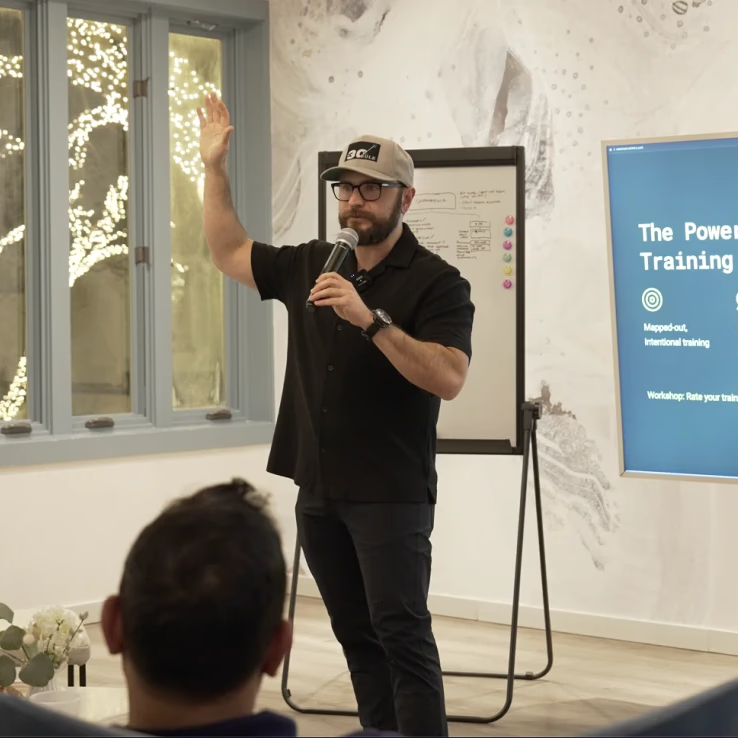
If you've never seen me before: my name is Bendik, I run a company called Closing Consulting. We help info, coaching, and service businesses scale from 6 to multi-7 figures in revenue by running and scaling their sales operations. Our teams have closed well into 8 figures in client revenue across offers from 3k to 20k and up.

On this channel I share what's working, what isn't, and what we're actively doing inside the sales ops we manage. My goal with these videos is simple: document the lessons we learn, attract top-tier talent to join our team, and attract the right partners by demonstrating competence first.

Quick note before we dive in: I'm not covering ad tools or funnel builders. This is the stack that kicks in after someone raises their hand and wants to talk to sales.

Capturing Leads: Typeform + Calendly

It all starts with how you capture the leads that get fed to the sales team.

For most of the offers we work with, we run a direct-to-application funnel: Ad or content → VSL or webinar → application form → book a call.

We use Typeform for the application, and here's why this tool is so powerful.

First, it actually looks good. On mobile, on desktop—it feels premium. But more importantly, it lets us ask real qualification questions. Things like "What's your current monthly revenue?" or "How much capital do you have available?" We're qualifying before anyone even gets on a call.

But here's what most people don't do: partial submissions.

We structure the form so name, email, and phone come first. And we tell Typeform to save that information as a partial application.

So even if someone abandons halfway through? We still have their contact info. Those partials flow straight into our CRM and setters start working them immediately, whilst email sequences get sent out to nurture the leads.

Now here's where it gets interesting. Instead of making someone fill out a form, hit submit, load a new page, pick a time for their call, and then fill out their info again—we embed Calendly directly as the last step of Typeform.

Typeform already has their details, so now the prospect simply makes one click to choose a time, and one click to confirm. No second form, no slow redirect to a thank you page. No friction.

That one change alone massively increases the percentage of people who actually get on the calendar. And people who book a call are always more committed than people who just filled out a form.

Managing Pipeline: Monday.com + GoHighLevel

Once someone applies or books, there are two questions: Where are they in the pipeline? And how are we talking to them?

For the pipeline, we use Monday.com as our CRM.

And listen, I've tried them all—Close, HubSpot, Pipedrive, GoHighLevel's pipeline, etc.

For high-ticket setter-closer teams, Monday wins for one simple reason: you can see the entire pipeline and all the key info on one screen without clicking into every card.

We build boards per offer with columns for lead source, stage, owner, next action, notes—everything. You can filter by closer, by date, by stage. It's like having the whole machine on one dashboard.

Now for actually communicating with leads, we use GoHighLevel.

That's where setters and closers make calls, where SMS and email sequences run, where nurture flows hit partials, no-shows, etc.

The first message we send out is always automated—that gives us speed-to-lead that can't be matched by humans alone. But every single touch point after that is personalized, and done manually by the setter team.

No one likes messages they know are automated, and no automation can personalize messages as well as a trained setter can.

And here's a little secret—we use a tool called Link Blue to get iMessage numbers inside GoHighLevel. When we text someone with an iPhone, it shows up as a blue bubble.

And because in the first message we write "this is Bendik from XYZ company," when the setter then calls them, most of the time their phone shows "inbound call from XYZ phone number - could be Bendik."

It feels like a real human, not some automation. Pickup rates go way up.

Internal Communication: Slack

You cannot run multiple sales teams out of email or random WhatsApp messages. It just doesn't work at scale.

We use Slack, and we set it up so the team has a live pulse on everything.

For each sales team we have a general channel and a dedicated alerts channel.

In alerts, Zapier posts whenever a new application comes in, a call gets booked, or a key stage changes—no-show, closed won, closed lost.

Our setters are basically trained like Pavlov's dogs at this point. Slack pings, they know a new lead just came in, and they can then jump on them right away, while the prospect is still thinking about the ad they saw.

We also have a customer wins channel where someone from our clients ops team drops customer wins—screenshots, testimonials and reviews, and success stories. That keeps the sales team emotionally sold on the offer and gives them fresh stories to use on calls.

Tracking Performance: Google Sheets + Looker Studio

Let's talk about how to track and measure performance.

This is where most teams either go full automation nerd trying to automate everything, leading to the reps not knowing their numbers and automations breaking so their numbers stop being trustworthy. Or, they drop the ball completely and don't track anything at all. This is more common than you'd think, even within 6 and 7 figure companies.

We deliberately mix manual and automated tracking.

Daily KPIs get entered manually into Google Sheets by setters and closers. Dials, pickups, sets, shows, closes, revenue—all of it. We do this on purpose. It forces reps to own their numbers and makes it obvious when someone's off. The other advantage to this is that we know the numbers are always correct. There's never any issues with integrations not working, or giving us the wrong data. And if you want to make quality decisions, you need to be data driven, and it's obvious that you have to be able to trust the data you base those decisions on.

On top of that, we use Typeform for end-of-day reports. It's a short form where we ask questions about the calls they had, what went well, why we lost deals, feedback on lead quality, etc.

These are transparent through the team, and leadership reviews them daily. It keeps a tight feedback loop without requiring tons of time spent daily by the team to "give status updates." Meetings can instead be minimised, and reserved for sales training or decision making. And let me tell you, the sales team loves this. When you get paid on commission, every hour you spend on a meeting is time you could spend closing deals.

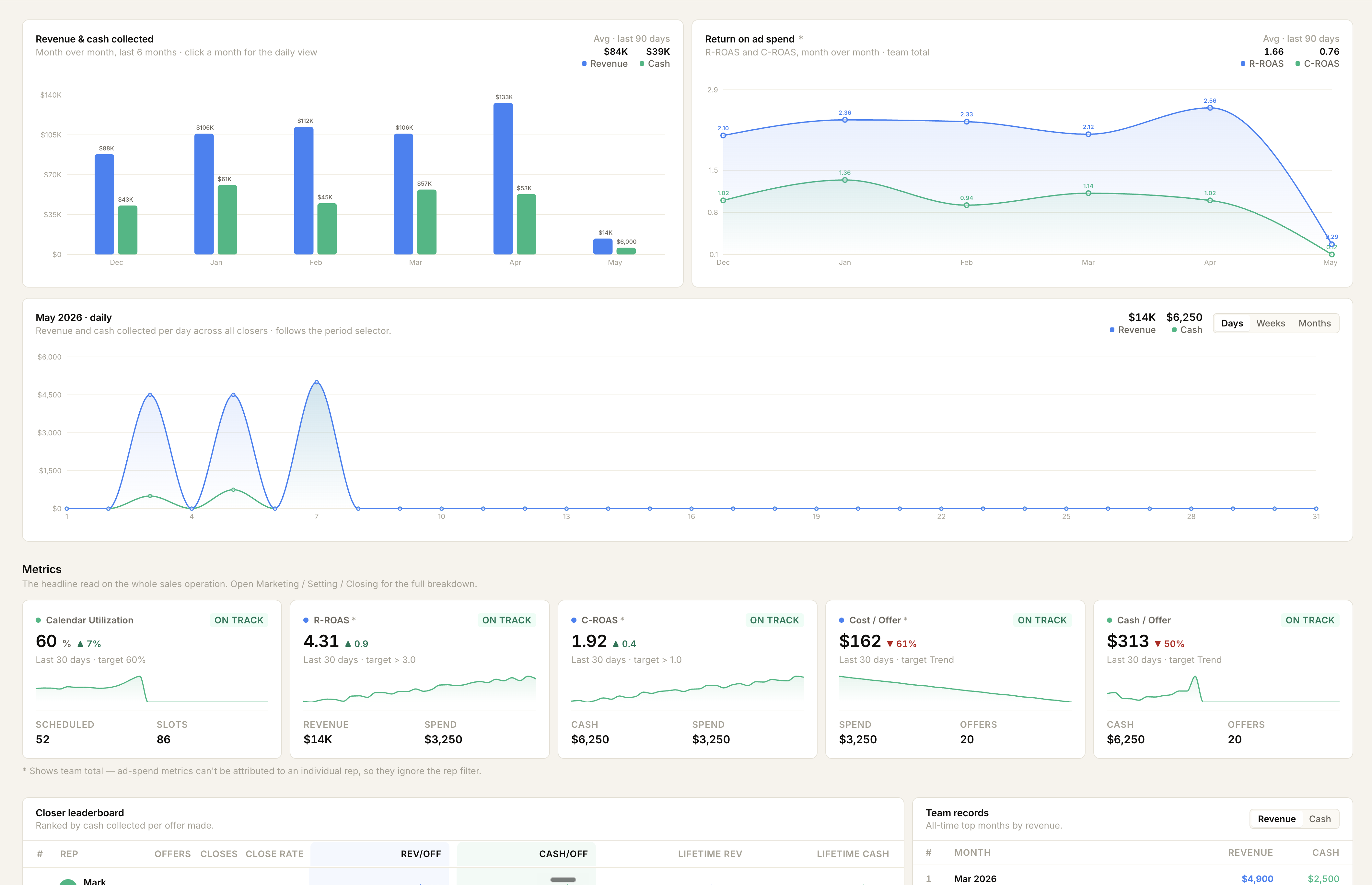
Once we have the data in the KPI trackers, we push all of that into Looker Studio to generate visual dashboards. Per offer, we can see exactly what's happening in each stage of the acquisition process. How much we spent on ads, lead and call volume, calendar utilization rate, cost per call, cash collected per call, etc.

This also shows us trends over time, so we're not just looking at numbers in a vacuum—we can see what's changing and why.

This kind of visibility is non-negotiable. It lets you make decisions based on real data, and it means revenue leaks get caught immediately instead of bleeding you dry for weeks.

Call Review and Training: Fathom + AI

This is actually my favorite part, and I attribute a lot of our success to this.

Most teams either drown in call recordings or just give up on reviewing them entirely. Here's how we do it differently.

We use Fathom for recording and transcription. It joins the sales calls, records everything, and gives us searchable transcripts.

Then we feed those transcripts into Claude and a custom AI we got access to through Acquisition.com—Alex and Leila Hormozi's PE firm. They've trained this thing on operational data from nine-figure businesses. It's not some generic ChatGPT prompt. It's built on real data from companies doing $250 million plus.

We're looking for compliance issues, patterns where reps lose deals, what's actually working, script problems, and voice-of-customer language we can hand back to marketing.

And again, AI doesn't replace human call reviews. It just increases the leverage of your time as a sales manager.

The standard management process is to pick a few random calls, watch maybe 5 hours out of a 40-hour week, and then conclude on what's broken in the sales process based on an opinion formed by seeing 10% of the work done.

What we do instead, is that AI processes the transcripts of 100% of the calls taken by the team. We then get a report showing us which calls and which timestamps are worth our time, based on what we know are the most likely compliance or performance issues for each rep. Then we go straight to those moments. It lets us be super precise, and spend more of our time actually fixing what's broken than aimlessly listening to a couple random calls from start to finish.

The mistake here is if you don't actually watch enough of the reps calls, and think ChatGPT can do this for you. That is absolutely not the case. But if you're smart about it, this gives you a tremendous amount of leverage.

Hiring & Onboarding

Let me talk about something most people completely overlook: hiring and onboarding.

We don't use some fancy recruiting software. We keep it inside our existing tools.

We have a talent pipeline board in Monday for all setter and closer candidates. Every stage is then tracked, from application to interview, testing, etc. Essentially we manage our talent leads the exact same way we manage the leads we close for our clients.

And once we do hire someone, we don't just schedule 10 hours of onboarding calls where we brain dump everything the closer needs to know about the offer, systems etc all at once.

Most companies do, but this turns into a mess. Quickly.

Instead, we've built out extensive playbooks and SOPs covering everything about our offers and operation in one place. This is hosted inside of Notion.

So when we onboard a new person to our team, 80% of the onboarding process is handled automatically. They learn about our SOPs, offer breakdowns, scripts, training videos, all in one place. We build out clear "Day 1, Week 1, Week 2" paths so new reps know exactly what to do and in what order.

This is the difference between hiring "a closer" and plugging someone into a real sales organization. When someone joins, they're not just jumping on a call and winging it. They get a full structured system. By the time we do the first onboarding call, they don't need a ton of training before they're ready to start handling live calls.

Payments and Financing

Let me talk about something that a surprisingly high number of high-ticket businesses completely sleep on: financing.

For payments we integrate with whatever fits the client. Stripe, Whop, their own processors—whatever we can use to take payments on the call.

But here's what actually moves the needle: offering financing options.

And let me be honest with you—this was a game changer for us.

Think about it from the buyer's perspective. You're asking someone to pay $5k, $10k, maybe $20k upfront. Or maybe you offer a payment plan—two or three big chunks. That's still a lot of money to pay all at once.

A lot of people who genuinely want to work with you, who would be great clients, just can't make that work.

But when you offer financing split over 12 to 24 months? Suddenly that $10k program is $400 a month. That's a completely different conversation.

As an example, one of our clients sells a $6k program teaching people how to invest in real estate. So everyone who buys the program has more than enough cash sitting around to pay for this upfront. Still, over 80% of the sales are done with our financing partners. Because even though they can technically afford it, they want to conserve their capital to actually buy real estate.

So if we couldn't offer this to them, we'd be losing out on tens of thousands of dollars in sales each month.

This is one of those things that seems small, so a ton of companies we talk to haven't bothered setting it up. But it completely changes your sales operation. You'll see more sales come through, and a higher cash collection rate.

The easiest way to get financing is either through Klarna on Stripe, or just getting an account on Whop where you can access Klarna, Splitit, etc.

There's dozens of different companies to go with, but the key is to work with someone who has a high acceptance rate, instant payouts, and low interest for the customer.

The Real Point

The point of this article isn't "go sign up for a bunch of new tools."

The point is that every single tool in our stack has a clear purpose. We've tested a lot of combinations, and this is the setup that works for the teams we run.

But here's the thing—the tools are only part of it. What actually makes this work is the system underneath: how the teams are trained, how we structure the pipeline, how we manage performance, how everything connects from marketing to close.

Get Started

Get Started

Get Started

Get Started

Get Started

Stop Loosing Deals To a Leaky sales operation

Book a call with our founder to explore whether your offer qualifies for full integration. No fluff. No pitch. Just a deep dive into your numbers, funnel, and sales process.

Evaluate your sales process

Identify obstacles to scaling your business

Devise a strategy based on your goals

Get Started

Get Started

Get Started

Get Started

Get Started

Stop Loosing Deals To a Leaky sales operation

Book a call with our founder to explore whether your offer qualifies for full integration. No fluff. No pitch. Just a deep dive into your numbers, funnel, and sales process.

Evaluate your sales process

Identify obstacles to scaling your business

Devise a strategy based on your goals

Testimonials

Testimonials

Testimonials

Testimonials

Testimonials

Hear From Some Of Our Clients

Here’s what happens when top-tier creators and info businesses hand us the keys to their sales.

Testimonials

Testimonials

Testimonials

Testimonials

Testimonials

Hear From Some Of Our Clients

Here’s what happens when top-tier creators and info businesses hand us the keys to their sales.

Testimonials

Testimonials

Testimonials

Testimonials

Testimonials

Hear From Some Of Our Clients

Here’s what happens when top-tier creators and info businesses hand us the keys to their sales.

© 2026 Closing Consulting. All rights reserved.