Written by

Bendik Eide Anskau

This real estate coach had a $5M portfolio, 20,000 followers, and a proven $4k coaching offer people actually wanted to buy. But his sales operation was such a mess that he was stuck at around $20k/month in revenue.
In just over 12 months, after we took over and rebuilt his entire sales operation from the ground up, he hit a record $320k month.
Here's exactly how we did it — what was broken, what we changed, and the key systems that turned it around.
A Good Offer Attached to a Broken Machine
Let me bring you back to the start.
Our client had spent three years building his real estate portfolio from scratch and documented his journey along the way on social media. He'd built an engaged audience that actually trusted him — in fact, he was getting hundreds of DMs every month from people asking how to buy their first investment property.
So he packaged his expertise into a $5k mentorship with an in-depth video program, weekly Q&As, and a community for ongoing support. After launching it, he and his co-founders took the first wave of calls themselves and quickly hit $10k to $30k a month.
Then they hit a ceiling.
To scale, they "built a sales team" — and I'm using air quotes here because what that actually looked like was a mess. There were no clear setter or closer roles, just a bunch of reps all dialing the same leads. No unified scripts, so everyone sold however they felt like it. No real training, people got tossed on calls to figure it out. No proper CRM, so leads got lost and follow-ups got missed. No KPI tracking, so no one knew where deals were actually dying. And no real management — no accountability, no coaching.
The founders were still jumping on calls and putting out fires, trying to manage a team on top of buying properties and running their other businesses. Revenue was swinging between $15k and $30k with zero predictability, and everyone knew the offer should be doing six figures a month. They were just bleeding deals through a leaky sales operation.
That's when they reached out.
Step One: Rebuild the Team Structure
When I audited their operation, I didn't see a system. I saw random salespeople with generic experience and no idea how to sell a high-ticket, life-changing offer.
We didn't try to fix a broken machine. We rebuilt it from scratch.
First, we cleared out the wrong people and brought in closers from our own network who we knew could handle high-ticket coaching offers. Then we implemented a proper structure to customer acquisition: marketing's job was to generate warm inbound leads through content, VSLs, lead magnets, and live webinars. Setters then quickly got in touch with those leads, qualified them, and got the right ones onto the closers' calendars. The closers' only job was to show up to their calls, follow the process, and collect cash.
Think of it like a production line, where each step feeds cleanly into the next without anyone juggling multiple responsibilities at once.
Step Two: Design the Setter and Closer Processes
With the structure in place, we designed the actual frameworks for each role.
Starting with the appointment setter: we got crystal clear on who was actually qualified for this offer. If you're teaching people to buy real estate, the key constraint is whether they can realistically buy a property in the next six months. If not, they're not going to drop thousands of dollars on a program built around doing exactly that. So the setter script focused first on understanding whether they had or could access financing within six months, then on defining their core problem and the goal behind investing in real estate, then on building urgency around solving it now rather than someday, and finally on getting explicit commitment — "If we can help, are you ready to start?"
By the end of a setter call, the closer had a qualified prospect on his calendar who'd already thought seriously about making a change, along with clear notes on their situation and obstacles in the CRM. The setter's real output wasn't just "calls booked." It was qualified, informed prospects who showed up with a sense of urgency.
The closer process picked up exactly where setters left off. They went deeper into the prospect's current situation, goals, and obstacles. They clarified why the prospect had been stuck so far, widened the emotional gap between staying put versus actually investing, walked them through the program as the bridge to cross that gap, and spent real time helping them work through their fears to make a decision on the call.
Step Three: Give the Machine Eyes and Ears
Before we came in, they had no idea what was actually happening in their sales process. And if you don't know where you're losing deals, you can't plug the leaks.
We implemented a proper CRM to track every lead at every step of the buying process, and a simple KPI system that separated inputs, process, and outputs. For setters, we tracked dials, pickups, real conversations, new appointments set, confirmed appointments, and show rates. For closers, we tracked calls booked, shows, offers made to qualified buyers, close rate, cash collected per call, and total revenue.
The key idea: the setter's output becomes the closer's input. If any number is off, you know exactly which part of the system to fix instead of just blaming "sales."
Dialing In the Team and Ramping Up
Once structure and systems were in place, it was about doing reps and improving the process. We ran daily huddles reviewing yesterday's numbers and setting the day's focus. We did regular call reviews for both setters and closers and kept tight feedback loops so everyone knew exactly where they stood.
We didn't let problems sit for months. If show rate, offer rate, or close rate dipped, we could spot the pattern within days and address it.
With that, we quickly stabilized the offer between $70k and $100k/month — purely on organic traffic. Then we added fuel to the fire. We raised the price from $4k to $5k, and because the sales process was tight, the close rate didn't budge. Then we brought in a team to run paid ads, giving us a way to control lead flow.
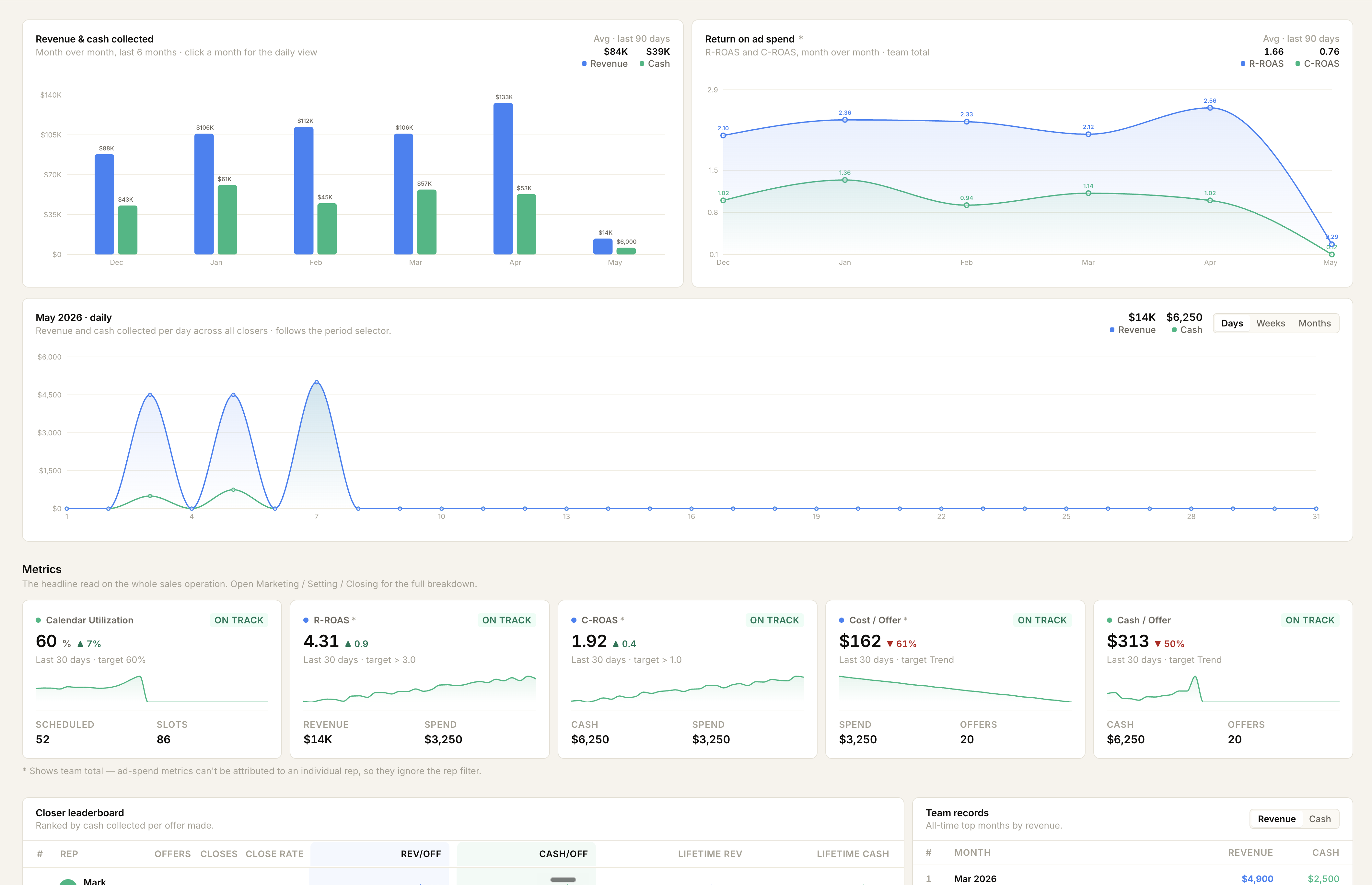
In the months that followed, we cracked $100k months, $150k months, then a $200k month. The sales engine was working, and we knew exactly how to scale capacity by hiring and training the right talent to handle the increased volume.
The Live Event That Broke the System (in a Good Way)
At that point, we decided to stress-test the system and see how much volume we could actually handle. Going into Q4, we ran a Cyber Monday live event — a two to three hour webinar where the coach walked through his story and exactly how he'd built his portfolio, gave a full breakdown of how to get started in real estate as a beginner, and pitched a time-limited discount for anyone who booked a call within 72 hours.
Over 1,000 people registered. Around 600 showed up live, and most stayed almost the entire time. When we dropped the application link at the end, the calendar was fully booked within 40 minutes — for two and a half weeks out.
The constraint wasn't demand anymore. It was capacity.
This is where the system we'd spent months building actually proved its worth. We had four setters calling every single applicant to qualify hard and clear out bad-fit calls, which freed up calendar space for serious buyers. They also called all attendees who hadn't applied, and even registrants who missed the event entirely, sending them the replay and booking the right ones on the calendar.
The results over roughly 30 days: 199 calls booked, 160 showed, 81 closed at approximately $4,300, totaling over $340k in revenue. With an 85% collection rate, that translated to $290k in cash. Plus another dozen or so deals in the following months from people who came from that event but needed more time.
And because the systems were in place, this wasn't a one-time spike. The business settled into consistently doing multi-six figures per month, with the founders spending about 30 minutes a week getting updates on the sales operation — not dozens of hours managing chaos.
What This Case Study Actually Demonstrates
There are three things worth taking from this.
First, a good offer and a warm audience are worthless if the sales machine behind them is broken. The ceiling most founders hit isn't a market problem. It's very often a sales ops problem.
Second, you can probably scale your revenue significantly by upgrading your team, restructuring the systems, and fixing the sales process before you need to pour more money into lead generation. Fixing the machine first means your ROAS actually makes sense when you do scale paid.
Third, one well-run event on top of a solid sales system can do more for your business than a year of running a broken one — but you need the right foundation underneath it for any of that to hold.
The ceiling you're sitting at right now is almost certainly not about your offer. Fix the machine, and the same offer with the same audience can produce a completely different business.