How To ACTUALLY Build a Sales Team That Scales To 7–8 Figure

How To ACTUALLY Build a Sales Team That Scales To 7–8 Figure

Written by

Avatar of author

Bendik Eide Anskau

If you run an info, coaching, or service business doing around $100k a month or more, and every month still feels like a white‑knuckle scramble to hit your number – juggling setters, testing new closers, hoping the calendar doesn’t fall apart – this is for you.

I’m going to walk you through the system we use to build and operate sales teams that actually scale to 7 and 8 figures in revenue, without you living on sales calls or crossing your fingers at the end of every month.

We’ll cover three parts:

  1. A simple systems‑thinking mental model for your customer acquisition

  2. How to design your setting and closing systems properly

  3. How to build “Navy Seals”‑level trust inside the team so the whole thing runs smooth

My name is Bendik, I run a company called Closing Consulting.

We help info, coaching, and service businesses scale from 6 to multi‑7 figures in revenue by running and scaling their sales operations. Our teams have closed well into 8 figures in client revenue across offers from $3k to $20k and up.

My goal with content like this is simple: document what’s actually working, attract top‑tier talent to join our team, and attract the right partners by demonstrating competence first.

Let’s dive in.


A Systems‑Thinking Mental Model For Acquisition

Every system is made of three parts:

  • Input – what goes in

  • Process – what happens to it

  • Output – what comes out

Simple example outside of sales:

In the Netflix show “Chef’s Table,” there’s an episode on Thomas Keller. He has seven Michelin stars. All of these chefs obsess over one thing: ingredients. They’re world‑class at cooking, but they know if the ingredients are garbage, the plate will never be great.

In other words: your process can be amazing, but if the input sucks, the output is capped.

Your acquisition is the same. It’s not “one funnel”. It’s a system made up of three subsystems.

1. The marketing system
  • Input: attention and ad spend

  • Process: content, funnels, webinars, VSLs

  • Output: leads and calls booked

2. The setting system
  • Input: leads and booked calls

  • Process: setters calling, texting, qualifying, and confirming

  • Output: qualified shows on the closers’ calendar

3. The closing system
  • Input: qualified shows

  • Process: the actual sales conversation and follow‑up

  • Output: closed deals, cash collected, and good‑fit customers

Visually, it’s one integrated machine:

Marketing output → becomes Setting input → becomes Closing input → creates Revenue.

If you want to put $1 into this system and reliably pull $10 out, each subsystem has to work.

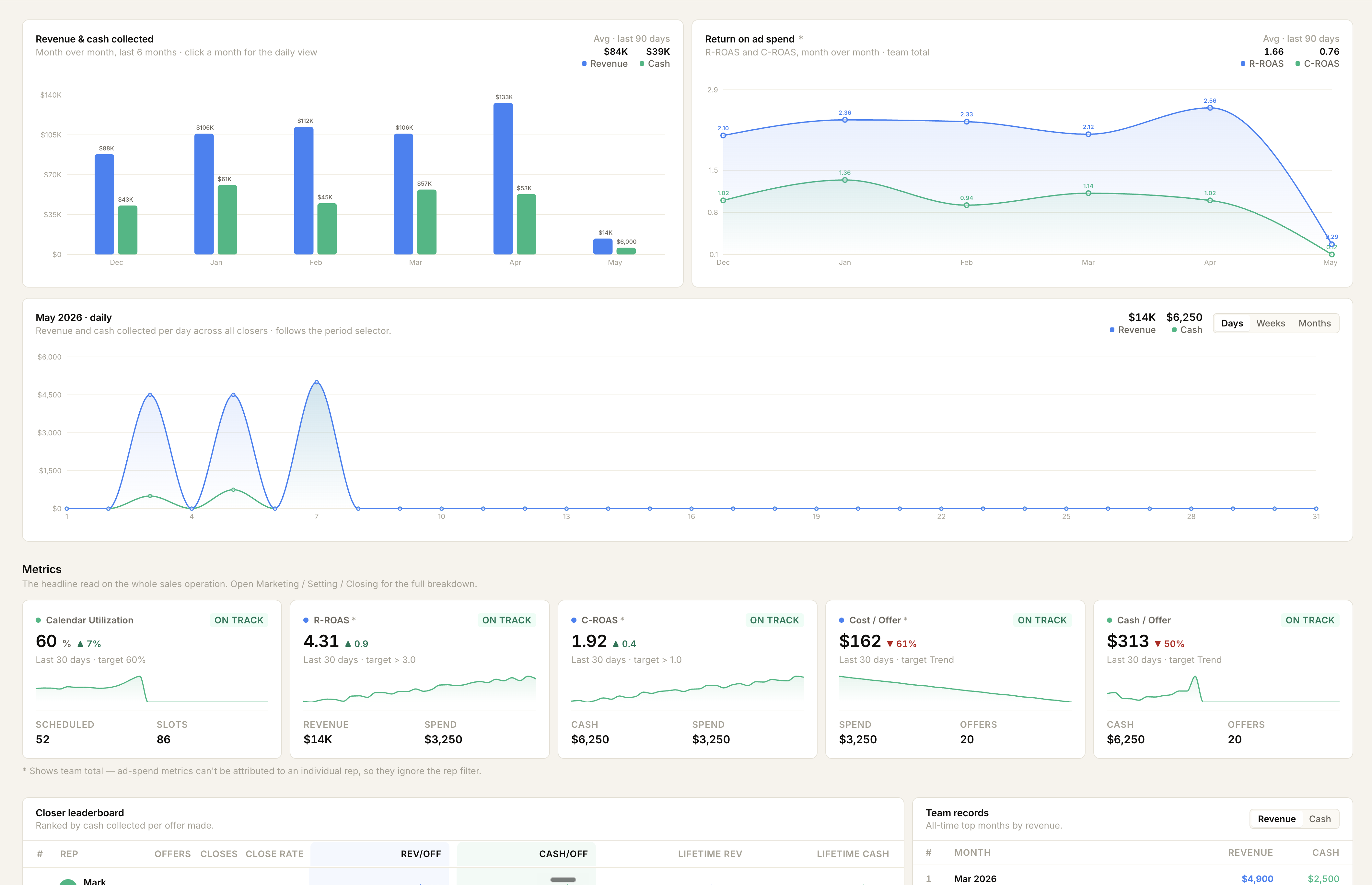
The whole point of tracking KPIs is not to make pretty dashboards. It’s to see which subsystem is broken.

  • If ROAS sucks but the sales metrics are strong, you have a marketing problem.

  • If show rates are trash but traffic is fine, you have a setting problem.

  • If everyone shows and nobody buys, you have a closing problem.

The job of the operator is to look at the KPIs, identify the failing subsystem, and drill down there – instead of randomly “working harder.”

For now, lock in this frame: Input → Process → Output across Marketing, Setting, and Closing.


Designing Your Setting & Closing Systems Properly

Once you understand the high‑level system, you can design the two sales subsystems properly: setting and closing.

The setting system: more than “booking calls”

Most people think the setter’s job is “book calls”.

That’s wrong.

The setter’s real job is: qualified prospects who show up in the right headspace.

They’re the ones turning raw attention into closable prospects.

Typical inputs into the setting process:

  • Event attendees

  • Lead magnet opt‑ins

  • Application submissions

  • People who directly book calls on a calendar

The setter’s process is to take those and do five things:

1. Define the problem and establish urgency

Questions like:

  • “What exactly are you trying to solve?”

  • “Why does this matter now, not ‘someday’?”

If there’s no real problem and no urgency, the rest is a waste of time.

2. Ensure they have enough information

If you sell a real‑estate investing offer, for example, they need a basic understanding of:

  • How real estate investing works

  • Who the coach is

  • How your strategy and methodology works

  • What it roughly takes to succeed

This is a great place for the setter to share videos and resources – “homework” – so they can make an educated decision on the closing call.

That stops the closing call from being an “information‑giving call” and turns it into a decision‑making conversation.

3. Build trust with the brand and coach

The prospect should end that first interaction thinking:

  • “These guys seem to be experts at solving this.”

  • “They understand where I’m at.”

  • “They’ve helped people in my shoes plenty of times.”

This is where you share relevant case studies and proof: success interviews, testimonials, screenshots, etc.

4. Pre‑frame a life‑changing decision

The setter’s job is to warm them up to the idea that the upcoming call is not “a quick chat.” It’s about making a real decision to make progress on their goals.

For example:

“You’ve been thinking about this for two years. If we find that we’re the right fit, are you actually ready to change your situation?”

5. Confirm the appointment and do a proper hand‑off
  • Confirm the appointment

  • Re‑confirm close to the time

  • Leave clean, concise notes in the CRM so the closer knows what they’re walking into

The output of the setting system is not “calls on the calendar.” It’s:

  • High show rate

  • Prospects with context

  • Enough insight that the closer can actually sell

That’s what we measure: show rate, qualified offers made, and a pipeline of warm prospects created – not sheer volume of “calls booked”.


The closing system: guiding decisions, not bulldozing

The input here is qualified shows and solid notes from the setter.

The closer’s job is not to “hard‑close people into yes.” It’s to lead the prospect through a high‑stakes decision‑making process.

We think about it in five steps:

1. Expand the gap they want to cross
  • Where are they now (point A)?

  • Where do they want to be (point B)?

  • Why does that matter in concrete terms?

2. Clarify the consequences of failure vs success

Questions like:

  • “What happens if nothing changes in 12 months?”

  • “What happens if you actually hit this goal?”

The goal is not to manipulate. It’s to get them to fully see the problem they said they want solved – and feel the emotions that will drive them to change.

3. Show how your offer bridges that gap

Only after they’re clear on A and B do you walk them through:

  • How your process works

  • Where people get stuck

  • How you help them through those spots

4. Help them overcome fear and decide

Most people on these calls are not confused. They’re scared.

They’ve been thinking about this for years, doing nothing. There’s a lot of emotion tied up in finally taking the first step.

Your job is to give them enough clarity, certainty, and the right perspective so they can make a decision today – yes or no – without feeling pressured or rushed.

Most high‑ticket purchases are not a “quick decision”. The decision builds over time:

  • Marketing attracts and pre‑frames

  • The setter filters out the fluff and warms up qualified prospects

  • The closer helps them finally commit

That only happens consistently if the rest of the system is dialed in.

5. Protect delivery and reputation

Saying “no” to bad‑fit clients is part of the closing system.

Wrong customers with wrong expectations ruin:

  • Your customer success metrics

  • Your testimonials

  • Your brand and team morale

You want closed deals that become case studies, not landmines.

Closed deals are one output. “Lost” deals are another.

Even if they don’t buy, every serious prospect should leave thinking:

“That was a good conversation. They were straight with me, didn’t feel pushy, and genuinely wanted to see me win. It might not be right for me now, but I’m happy to recommend them.”

Over time that shows up as brand, referrals, and easier closes.


Building “Navy Seals”‑Level Trust Inside The Team

None of this matters if the team doesn’t trust each other enough to operate as one.

There’s a quote I like from Alex Hormozi:

“You don’t become confident by shouting affirmations in the mirror, but by having a stack of undeniable proof that you are who you say you are.”

Trust inside a sales team works the same way.

You don’t build trust by saying, “We’re a family,” or “We’re a great team.”

You build it by stacking undeniable proof, every day, that everyone does their job.

Concretely, in a setter‑closer team, that looks like:

  • The setter always confirms appointments

  • The setter writes clear, useful notes – no fluff

  • Everyone fills out their KPIs and EODs on time

  • The closer runs tight, respectful calls and updates the CRM

  • Both sides give and receive feedback like adults

  • They actually talk during the day, not just live in separate silos


Two parallel universes

Universe 1: No trust

  • The setter doesn’t confirm calls

  • Notes are sloppy or missing

  • KPIs and EODs are never filled in

  • The closer shows up thinking:“Is this person even going to show? What am I walking into? Why do I even bother?”

They start the call annoyed and off their game.

Universe 2: High trust

  • Every call is confirmed

  • Notes are clear, to the point, and always there

  • KPIs and EODs are updated daily

  • In the morning, the setter messages:“Here are your calls today. All confirmed. Notes are in the CRM. Let me know if you need anything.”

How does that closer show up?

Confident. Focused. Motivated to give 100%, because someone else clearly cares about doing their job right.

And it goes the other way too: when the setter sees the closer giving real feedback, respecting the leads, and updating numbers, they’re much more willing to push hard on their side.

They can confidently hand off the work they’ve done, trusting it won’t be wasted.

You don’t rise to the level of your goals, you fall to the level of your preparation and systems.

Your sales team has to operate like one engine:

  • Everyone understands the full system

  • Everyone owns their piece of the process

  • Everyone behaves in a way that makes the rest of the team’s job easier, not harder

Do that, and scaling to 7 and 8 figures becomes a question of volume and offer, not raw muscle.


Putting It All Together

Quick recap:

  • Treat your acquisition as three connected systems: marketing, setting, closing

  • Design your setting and closing so the real outputs are qualified shows, offers made, cash collected, and reputation, not vanity numbers

  • Build trust by creating a culture where everyone proves, daily, that they can be counted on

That’s how you create a sales operation that can actually scale, consistently.

Get Started

Get Started

Get Started

Get Started

Get Started

Stop Loosing Deals To a Leaky sales operation

Book a call with our founder to explore whether your offer qualifies for full integration. No fluff. No pitch. Just a deep dive into your numbers, funnel, and sales process.

Evaluate your sales process

Identify obstacles to scaling your business

Devise a strategy based on your goals

Get Started

Get Started

Get Started

Get Started

Get Started

Stop Loosing Deals To a Leaky sales operation

Book a call with our founder to explore whether your offer qualifies for full integration. No fluff. No pitch. Just a deep dive into your numbers, funnel, and sales process.

Evaluate your sales process

Identify obstacles to scaling your business

Devise a strategy based on your goals

Get Started

Get Started

Get Started

Get Started

Get Started

Stop Loosing Deals To a Leaky sales operation

Book a call with our founder to explore whether your offer qualifies for full integration. No fluff. No pitch. Just a deep dive into your numbers, funnel, and sales process.

Evaluate your sales process

Identify obstacles to scaling your business

Devise a strategy based on your goals

Testimonials

Testimonials

Testimonials

Testimonials

Testimonials

Hear From Some Of Our Clients

Here’s what happens when top-tier creators and info businesses hand us the keys to their sales.

Testimonials

Testimonials

Testimonials

Testimonials

Testimonials

Hear From Some Of Our Clients

Here’s what happens when top-tier creators and info businesses hand us the keys to their sales.

Testimonials

Testimonials

Testimonials

Testimonials

Testimonials

Hear From Some Of Our Clients

Here’s what happens when top-tier creators and info businesses hand us the keys to their sales.

© 2026 Closing Consulting. All rights reserved.